
7 Warning Signs Your Commercial Parking Lot Needs Attention Before Winter
7 Warning Signs Your Commercial Parking Lot Needs Attention Before Winter
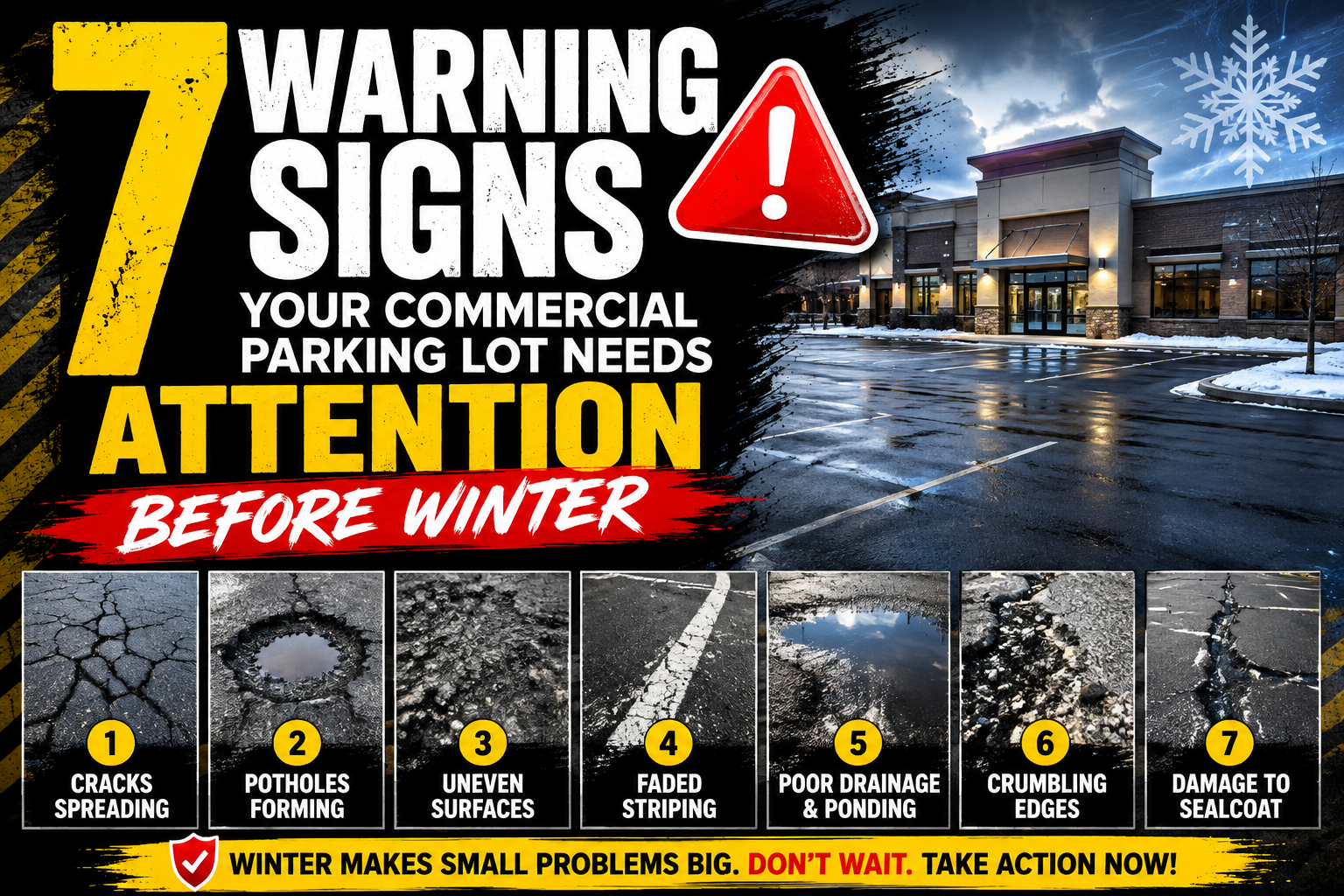
Your parking lot may look fine from the front entrance, but a closer inspection can tell a very different story.
Small cracks, faded pavement, standing water, and a few shallow potholes are easy to put off. After all, customers can still park, delivery trucks can still get through, and the pavement hasn’t completely failed.
The problem is that minor asphalt damage rarely stays minor.
As Georgia moves from the intense heat and storms of summer into cooler fall and winter weather, existing pavement problems can become more serious. Addressing them early can help commercial property owners avoid larger repairs, improve the appearance of their property, and extend the useful life of their pavement.
Here are seven warning signs that your parking lot may need professional attention.
1. Cracks Are Starting to Spread
A single small crack may not seem urgent. Multiple cracks spreading across your parking lot are another matter.
Cracks create openings that allow water to penetrate the pavement. Once moisture reaches the underlying layers, the stability of the pavement can begin to deteriorate.
Different crack patterns can also indicate different problems. Long cracks, interconnected cracks, and alligator-style cracking can point to issues ranging from normal aging to more significant pavement failure.
The important thing is not to ignore them.
Early crack repair can be considerably simpler than repairing pavement after the surrounding asphalt begins breaking apart.
2. Potholes Keep Coming Back
You repair a pothole.
A few months later, it’s back.
Or another one appears five feet away.
Recurring potholes may indicate that the problem extends deeper than the pavement surface. Water intrusion, poor drainage, base failure, and repeated heavy vehicle traffic can all contribute to pothole formation.
This is especially important for commercial properties that regularly accommodate delivery trucks, garbage trucks, buses, trailers, or other heavy vehicles.
Repeatedly patching the surface may not solve a deeper pavement problem.
A professional asphalt contractor can evaluate the damaged area and determine whether it needs pothole repair, asphalt patching, resurfacing, or more extensive reconstruction.
3. Water Sits in the Parking Lot After It Rains
After a Georgia thunderstorm passes, take a walk around your parking lot.
Do you see large puddles that remain long after the rain stops?
Standing water is more than an inconvenience.
Water that consistently collects in low areas can seep into cracks and damaged pavement. Over time, this moisture can contribute to deterioration beneath the asphalt.
Pooling water may also be a sign that the parking lot’s slope, drainage, or pavement surface is no longer performing as intended.
Considering how much rainfall Georgia can receive, good parking lot drainage is an important part of protecting an asphalt surface.
4. The Pavement Is Starting to Crumble Around the Edges
Pay attention to areas where the parking lot meets landscaping, curbs, drainage areas, driveways, and unpaved surfaces.
Are the edges breaking apart?
Do you see loose pieces of asphalt?
Edge deterioration can gradually work its way farther into the parking lot. Traffic passing close to weakened pavement can accelerate the problem.
Repairing deteriorated areas before they expand may help prevent a relatively small problem from becoming a much larger section of failed pavement.
5. The Parking Lot Looks Gray, Dry, and Worn
Fresh asphalt has a rich, dark appearance. As pavement ages and is exposed to sunlight, rain, traffic, oil, chemicals, and temperature changes, that appearance gradually fades.
Color alone doesn’t determine whether pavement needs replacement.
However, an increasingly gray and brittle surface can be one indication that the asphalt is aging.
Look for additional symptoms such as:
- Loose aggregate
- Surface cracking
- Rough areas
- Small pieces of pavement breaking away
- Widespread deterioration
When several of these symptoms appear together, it may be time to have the pavement professionally evaluated.
6. Customers Are Starting to Notice the Parking Lot
Property owners see their parking lots every day.
Customers don’t.
That difference matters.
You may have gradually become accustomed to a cracked entrance, faded pavement, or rough driving lane. Someone visiting your business for the first time sees it immediately.
The parking lot is often one of the first physical interactions a customer has with your property.
A smooth, well-maintained parking area can contribute to a cleaner and more professional appearance. Severely damaged pavement can have the opposite effect.
For shopping centers, restaurants, hotels, medical facilities, office buildings, churches, apartment communities, and other commercial properties, pavement condition can become part of the overall customer experience.
7. You’re Planning to “Deal With It Next Year”
This may be the biggest warning sign of all.
Asphalt problems don’t follow your capital improvement schedule.
If a parking lot already has visible deterioration, waiting another six months or a year could allow water, traffic, and weather to make the damage worse.
That doesn’t necessarily mean you need to repave the entire parking lot immediately.
A professional inspection may reveal that targeted repairs can address the most vulnerable areas. In other cases, resurfacing may be a better long-term investment than continuing to patch failing pavement.
The key is understanding the actual condition of the parking lot before deciding what to do.
Repair, Resurface, or Repave?
One of the most common questions commercial property owners have is:
“Does my parking lot really need to be replaced?”
Not necessarily.
The appropriate solution depends on the pavement’s age, condition, drainage, base stability, traffic load, and extent of the damage.
Asphalt Repair
Localized repairs may be appropriate when damage is limited to specific sections of otherwise serviceable pavement.
Asphalt Resurfacing
Resurfacing may be an option when a larger portion of the pavement surface has deteriorated but the underlying structure remains suitable.
Asphalt Repaving or Reconstruction
When deterioration is widespread or the pavement structure has significantly failed, more extensive paving work may provide a better long-term solution.
An experienced asphalt paving contractor can evaluate these factors and recommend an approach based on the actual condition of the property.
Don’t Wait Until Your Parking Lot Becomes an Emergency
The best time to address pavement problems is usually before they become major pavement failures.
Walk your property periodically and look for changes. Pay particular attention after periods of heavy rain and around high-traffic areas, entrances, loading zones, dumpsters, drainage structures, and locations used by heavy trucks.
If something looks different than it did a few months ago, don’t automatically assume it’s cosmetic.
Your pavement may be telling you something.
Need Commercial Asphalt Repair or Paving in Georgia?
Road Mix provides professional asphalt paving, parking lot repair, resurfacing, pothole repair, crack filling, and pavement maintenance services for commercial and industrial properties throughout Georgia.
Whether you’re responsible for a retail shopping center, warehouse, distribution center, restaurant, hotel, apartment community, medical facility, church, school, office property, manufacturing facility, or other commercial site, our team can evaluate your pavement and help determine the appropriate next step.
Don’t wait for a few cracks to turn into a parking lot full of expensive problems.
Contact Road Mix today to schedule an asphalt pavement evaluation and discuss your property’s paving or repair needs.
Recent Posts
- 7 Warning Signs Your Commercial Parking Lot Needs Attention Before Winter
- Your Parking Lot Has a Lifespan — Here’s How to Make It Last Longer
- Asphalt vs. Concrete Parking Lots: Which Is the Better Investment for Your Property?
- How Georgia’s Heat and Heavy Rain Destroy Your Asphalt (And What You Can Do About It)
- What Your Asphalt Is Trying to Tell You: 7 Warning Signs You Should Never Ignore
Archives

Experienced Professionals
Years of Industry Expertise
Superior Quality
Premium Materials & Wormanship
Reliable Service
On-Time & On-Budget
