Your Parking Lot Has a Lifespan.
Here’s How to Make It Last Longer
Your Parking Lot Has a Lifespan
Here’s How to Make It Last Longer
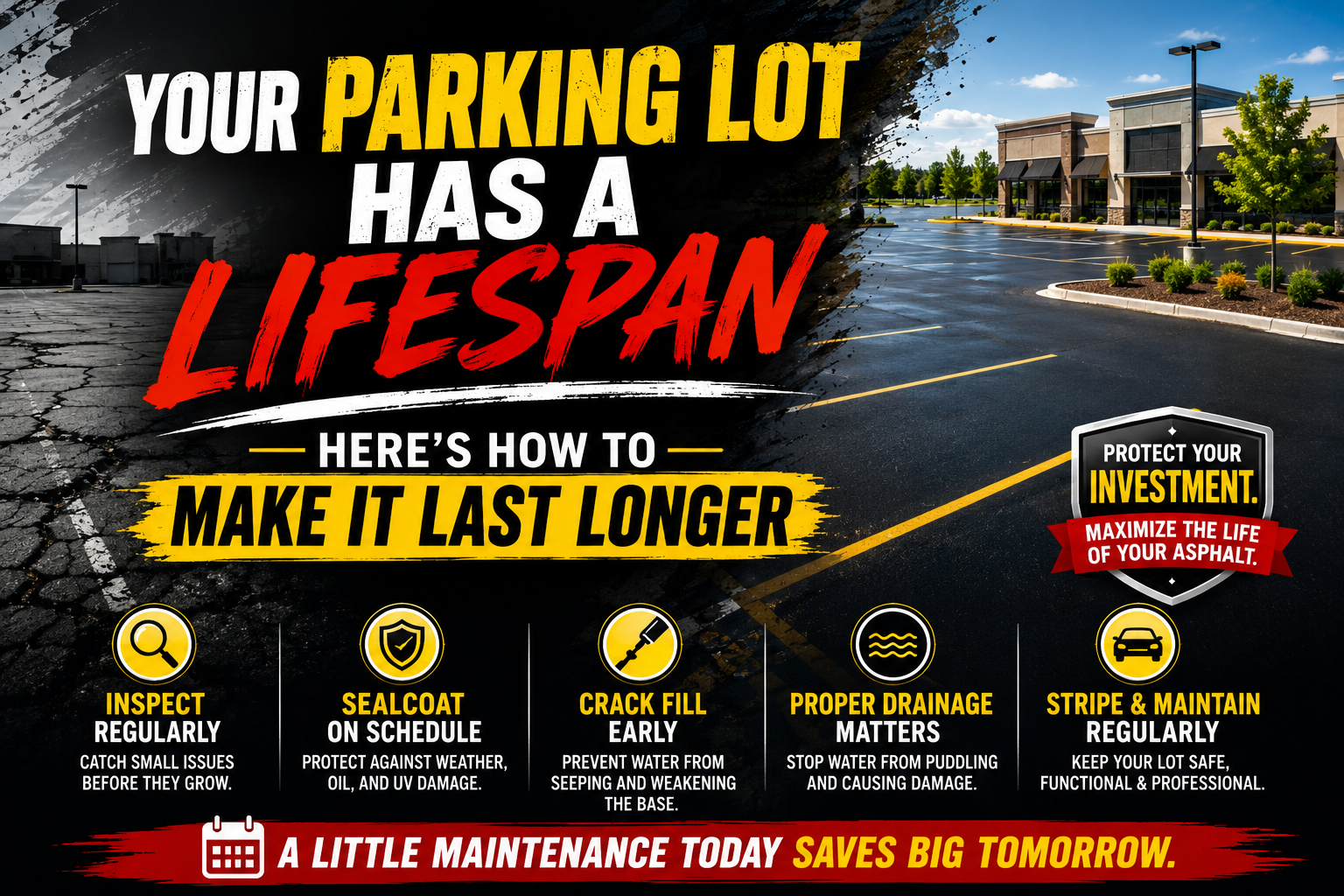
A commercial parking lot is easy to forget about when everything is working properly.
Cars pull in. Customers park. Delivery trucks make their stops. Employees come and go.
Then one day, you notice a few cracks.
A pothole appears near the entrance. Water starts collecting in one corner after heavy rain. The pavement looks rougher than it did a few years ago.
What happened?
Your asphalt parking lot has been aging every single day.
The good news is that pavement deterioration doesn’t always mean it’s time for a complete replacement. Knowing what damages asphalt — and addressing problems at the right time — can help you get more useful life from your parking lot.
Here’s what Georgia commercial property owners should know.
Asphalt Starts Aging the Day It’s Installed
Asphalt is durable, but it isn’t indestructible.
From the moment a parking lot is completed, it begins facing constant exposure to traffic, sunlight, rain, heat, vehicle fluids, heavy loads, and changing temperatures.
Georgia can be especially demanding on pavement.
Summer temperatures heat asphalt surfaces for hours at a time. Afternoon thunderstorms can dump significant amounts of water onto a property in a short period. Commercial traffic repeatedly stresses the pavement.
One event usually isn’t what causes a parking lot to fail.
It’s the cumulative effect of thousands of small stresses over time.
That’s why preventive parking lot maintenance can make such a difference.
Water Is One of Asphalt’s Biggest Enemies
If there’s one thing commercial property owners should pay attention to, it’s water.
When an asphalt surface is intact and drainage is working correctly, rainwater can move away from the pavement.
Cracks change the equation.
Water can enter through cracks and reach the pavement’s underlying layers. If those supporting layers weaken, the pavement above can begin moving, sinking, cracking, or breaking apart.
This is one reason a seemingly harmless crack shouldn’t automatically be ignored.
The crack you see on top may be giving water access to areas you can’t see underneath.
After heavy rainfall, inspect your property.
Look for standing water, drainage problems, low spots, cracks holding water, deteriorating pavement around drains, and areas where water flows across damaged asphalt.
Small Cracks Deserve Attention
It’s easy to look at a narrow crack and think:
“I’ll worry about that when it gets bigger.”
Unfortunately, that’s often exactly what happens.
Traffic continues passing over the area. Rainwater finds its way into the opening. The pavement continues aging.
The crack grows.
Eventually, what might have been addressed through crack filling or a localized repair can become a larger pavement problem.
Not every crack requires the same repair method, either. The pattern, width, depth, location, and underlying cause all matter.
Having cracks evaluated early gives you more options.
Don’t Let Potholes Become Permanent Residents
Every commercial property seems to have that one pothole.
Employees know where it is.
Delivery drivers know where it is.
Regular customers know exactly how to drive around it.
If people have learned to avoid a pothole in your parking lot, it has probably been there too long.
Potholes aren’t just unattractive. They can continue deteriorating as vehicles strike their edges and water enters the damaged pavement.
They can also create an unpleasant first impression for customers entering your property.
More importantly, recurring potholes can sometimes indicate a problem below the surface.
If the same area keeps failing after repairs, it may be time to determine why instead of simply patching it again.
Heavy Trucks Change Everything
Not all parking lots experience the same traffic.
A small professional office may primarily accommodate passenger vehicles.
A warehouse or distribution center is a completely different environment.
Commercial pavement may regularly support:
- Tractor-trailers
- Delivery trucks
- Garbage trucks
- Service vehicles
- Buses
- Box trucks
- Heavy equipment
These vehicles place significantly greater stress on pavement than ordinary passenger cars.
Loading docks, dumpster areas, entrances, truck lanes, turnaround areas, and delivery zones often show deterioration sooner because of repeated heavy loads and turning movements.
If your property handles substantial commercial vehicle traffic, these areas deserve extra attention during pavement inspections.
Pay Attention to Your Dumpster Area
Here’s an area property owners frequently overlook.
Walk out to your dumpster enclosure and look at the pavement around it.
What do you see?
Garbage trucks are heavy. They repeatedly approach the same area, stop, maneuver, lift loaded containers, and leave.
Over time, this repeated activity can contribute to cracking, depressions, rutting, and pavement failure.
The same principle applies to loading docks and frequently used delivery areas.
Your entire parking lot doesn’t necessarily age at the same rate.
High-stress areas may require repairs long before lower-traffic sections of the property.
Keep Drainage Areas Clear
Your pavement and drainage system work together.
Storm drains, catch basins, gutters, and other drainage features need a clear path for water.
Leaves, dirt, trash, landscaping debris, and sediment can interfere with drainage and contribute to standing water.
Property managers should periodically inspect drainage areas, particularly before and after periods of heavy rainfall.
If water repeatedly pools in the same place even when drains are clear, the pavement itself may need to be evaluated.
Fix Failed Areas Instead of Paving Over the Problem
Sometimes damaged pavement needs more than a surface treatment.
If the pavement or underlying base has failed, simply covering the area may not address the cause.
That’s where professional evaluation becomes important.
Depending on the condition of the parking lot, a contractor may recommend localized asphalt repair, full-depth patching, crack filling, resurfacing, or complete pavement reconstruction.
The goal shouldn’t be to choose the biggest repair.
It should be to choose the appropriate repair for the condition of the pavement.
Know When Resurfacing Makes Sense
Eventually, every asphalt parking lot reaches a point where individual repairs become less practical.
If the surface is extensively worn or cracked but the underlying pavement structure remains suitable, asphalt resurfacing may be an option.
Resurfacing generally involves preparing the existing pavement and installing a new asphalt surface over it.
For the right parking lot, this can restore appearance and performance without completely reconstructing the pavement.
However, resurfacing isn’t the solution for every property.
Significant base failure, severe drainage issues, or widespread structural deterioration may require more extensive work.
That’s why the condition underneath the visible surface matters.
Don’t Wait Until You’re Planning a Major Event
There’s an oddly predictable moment when many property owners suddenly notice their parking lot.
Right before something important happens.
A grand opening.
Corporate inspection.
Tenant move-in.
Major customer visit.
Holiday shopping season.
Community event.
Property sale.
Then everyone looks outside and realizes the pavement doesn’t match the rest of the property.
Instead of waiting for a deadline, include pavement in your normal property maintenance routine.
A simple periodic walk-through can reveal problems while they’re still manageable.
Think of Your Parking Lot as an Asset
Commercial pavement represents a significant investment.
Treating it like an asset changes how you approach maintenance.
Instead of asking:
“How long can we wait before fixing this?”
A better question may be:
“What should we do now to protect what we’ve already invested in?”
That doesn’t mean repairing every cosmetic imperfection immediately.
It means watching for meaningful deterioration and addressing problems strategically.
Create a Simple Parking Lot Inspection Routine
You don’t need to be an asphalt expert to spot changes in your pavement.
Every few months, walk the property and look for:
- New or expanding cracks
- Potholes
- Crumbling pavement
- Standing water
- Depressions or low spots
- Rutting in driving lanes
- Damage near storm drains
- Deterioration around dumpsters
- Damage near loading docks
- Worn high-traffic areas
- Loose pavement material
- Areas that have noticeably changed since your last inspection
Take photos of questionable areas.
Photos make it much easier to determine whether a crack, depression, or damaged section is getting progressively worse.
Repair Today or Replace Tomorrow?
There’s no maintenance strategy that can make asphalt last forever.
Eventually, pavement reaches the end of its useful life.
The goal is to avoid reaching that point unnecessarily early.
Catching deterioration early may allow you to repair specific areas instead of replacing larger sections later.
And when resurfacing or repaving eventually becomes necessary, planning ahead gives you time to budget, coordinate traffic, notify tenants, and schedule the project with less disruption.
Protect Your Commercial Pavement Investment
Your parking lot works every day, even when you’re not thinking about it.
Taking care of small problems, monitoring drainage, paying attention to high-stress areas, and scheduling professional repairs when needed can help you get more value from your pavement investment.
If you’re seeing cracks, potholes, drainage problems, worn pavement, or larger areas of deterioration, Road Mix can help determine what your property needs.
Road Mix provides professional commercial asphalt paving, parking lot paving, asphalt repair, parking lot repair, asphalt resurfacing, pothole repair, crack filling, and pavement maintenance services throughout Georgia.
From retail centers and restaurants to warehouses, distribution centers, hotels, churches, schools, medical facilities, office buildings, apartment communities, and industrial properties, we understand that every parking lot has different traffic patterns and pavement demands.
Don’t wait until a manageable pavement problem becomes a major paving project.
Contact Road Mix today to discuss your commercial parking lot and schedule a professional pavement evaluation.
Recent Posts
- 7 Warning Signs Your Commercial Parking Lot Needs Attention Before Winter
- Your Parking Lot Has a Lifespan — Here’s How to Make It Last Longer
- Asphalt vs. Concrete Parking Lots: Which Is the Better Investment for Your Property?
- How Georgia’s Heat and Heavy Rain Destroy Your Asphalt (And What You Can Do About It)
- What Your Asphalt Is Trying to Tell You: 7 Warning Signs You Should Never Ignore
Archives

Experienced Professionals
Years of Industry Expertise
Superior Quality
Premium Materials & Wormanship
Reliable Service
On-Time & On-Budget
